
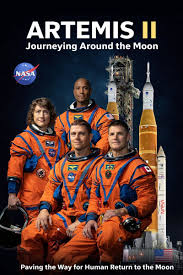
After half a century, NASA has successfully launched the Artemis II mission, once again sending humans toward the Moon. This launch, originating from Cape Canaveral, Florida, marks the beginning of a new era in human space exploration.
According to the plan, the astronauts will first spend approximately 24 hours in Earth’s orbit to verify all systems aboard the Orion spacecraft, after which they will embark on a three-day journey toward the Moon. This mission is historic both in terms of the distance covered and because it will take humans beyond Earth’s protective magnetic field—into the radiation-filled environment of deep space—for the very first time. Upon approaching the Moon, the crew will orbit its “far side”—the hemisphere that no human has ever directly witnessed with their own eyes. Artemis II is regarded as the modern-day equivalent of the 1968 Apollo 8 mission, when humans first orbited the Moon.
Four Astronauts, Multiple Historic Achievements
The crew for this mission comprises NASA’s Reid Wiseman, Victor Glover, and Christina Koch, alongside Canada’s Jeremy Hansen. This mission is set to establish several historic milestones: Victor Glover will become the first Black person to enter lunar orbit; Christina Koch will become the first woman to do so; and Hansen will become the first non-American astronaut to venture beyond Earth’s orbit. During the journey, the crew will conduct a series of scientific experiments, including studies on the effects of deep space on human health, the impact of radiation, and unprecedented observations of the lunar surface.
नासा ने आधी सदी बाद इन्सानों को फिर चंद्रमा की दिशा में भेजते हुए आर्टेमिस-2 मिशन को सफलतापूर्वक लाॅन्च कर दिया है। फ्लोरिडा के केप कैनावेरल से हुए इस प्रक्षेपण के साथ मानव अंतरिक्ष अन्वेषण के एक नए दौर की शुरुआत हुई।
योजना के अनुसार अंतरिक्ष यात्री पहले करीब 24 घंटे पृथ्वी की कक्षा में रहकर ओरियन स्पेसक्राफ्ट की सभी प्रणालियों की जांच करेंगे, जिसके बाद वे तीन दिन की यात्रा पर चंद्रमा की ओर बढ़ेंगे। यह मिशन दूरी व इन्सानों को पहली बार पृथ्वी के सुरक्षात्मक मैग्नेटिक फील्ड से बाहर ले जाकर डीप स्पेस के रेडिएशन-भरे वातावरण में ले जाने के कारण ऐतिहासिक है। चंद्रमा के करीब पहुंचने पर यह दल उसके फार साइड यानी वह हिस्सा, जिसे अब तक किसी इन्सान ने सीधे अपनी आंखों से नहीं देखा, की परिक्रमा करेगा। आर्टेमिस-2 को 1968 के अपोलो-8 मिशन के समकक्ष माना जा रहा है, जब पहली बार इन्सानों ने चंद्रमा की परिक्रमा की थी।
चर यात्री, कई ऐतिहासिक उपलब्धियां
इस मिशन में नासा के रीड वाइजमैन, विक्टर ग्लोवर और क्रिस्टीना कोच के साथ कनाड़ा के जेरमी हैनसेन शामिल हैं। यह मिशन कई ऐतिहासिक पड़ाव स्थापित करेगा विक्टर ग्लोवर चंद्रमा की कक्षा में जाने वाले पहले अश्वेत व्यक्ति होंगे, क्रिस्टीना कोच पहली महिला होंगी और हैनसेन पृथ्वी की कक्षा से बाहर जाने वाले पहले गैर-अमेरिकी अंतरिक्ष यात्री बनेंगे। यात्रा के दौरान दल मानव स्वास्थ्य पर डीप स्पेस के प्रभाव, विकिरण के असर और चंद्रमा की सतह के अभूतपूर्व अवलोकन जैसे कई वैज्ञानिक प्रयोग करेगा।